Exhibition Dates:
Through SEPTEMBER 7, 2026
Hours:
MON. TO SAT. 10AM TO 4PM. SUN. NOON TO 4PM
Location:
Balzekas Museum of Lithuanian Culture
6500 S. Pulaski Rd., Chicago IL 60629
Exhibition free with admission to the Balzekas Museum
Major Exhibition at the Balzekas Museum Highlights the Legacy and Impact of 125 Years of Lithuanian Immigrant Artists in Chicago
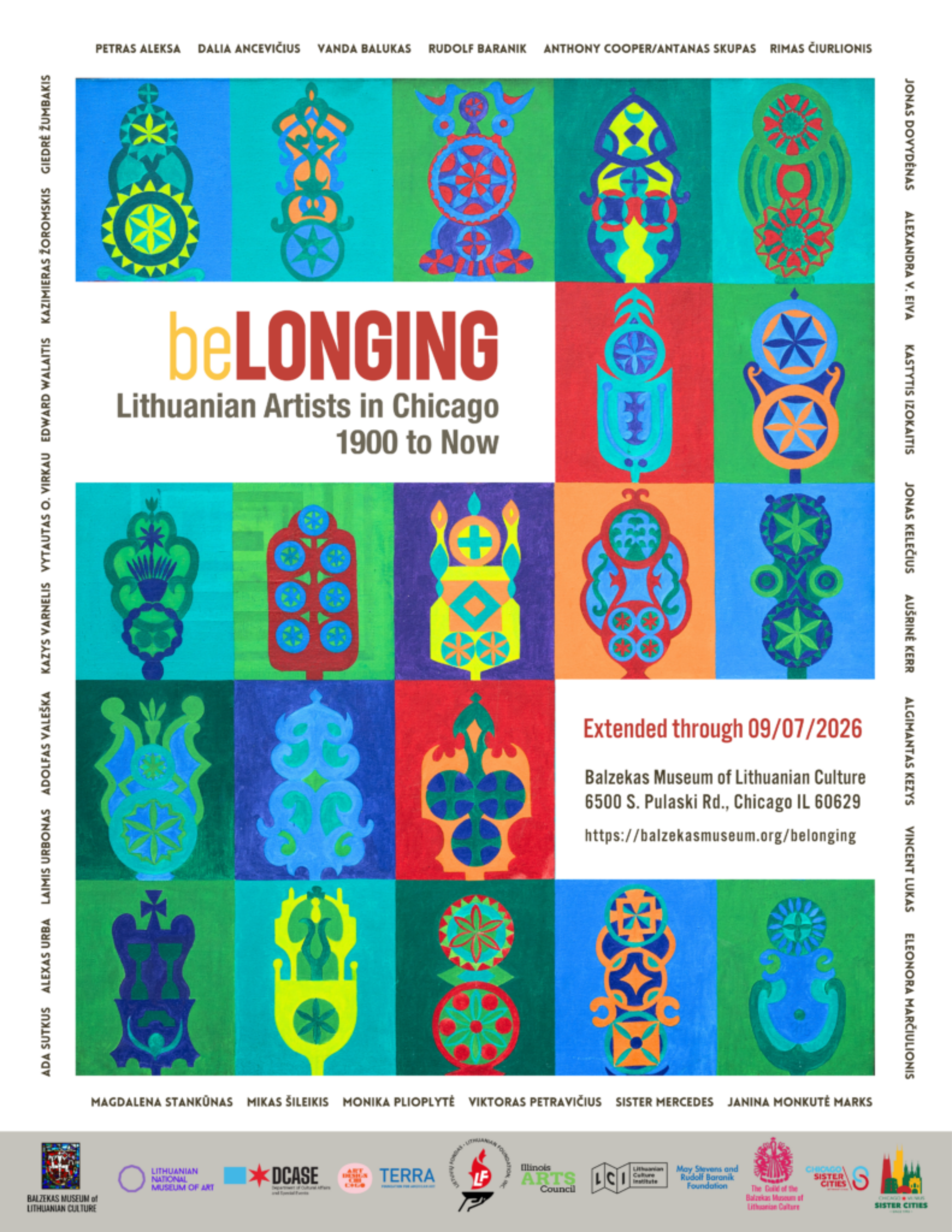
beLONGING: Lithuanian Artists in Chicago, 1900 to Now
EXHIBITION NOW EXTENDED THROUGH SEPT. 7, 2026
(Chicago, IL, August 24, 2024) The Balzekas Museum of Lithuanian Culture announces a major exhibition showcasing over a century of art by Lithuanian immigrant artists with ties to Chicago. Three years in the making, the exhibition beLONGING: Lithuanian Artists in Chicago, 1900 to Now reveals the role and impact of these artists within Chicago’s rich cultural landscape and beyond. The first such expansive survey, beLONGING features nearly 30 artists representing three waves of immigration to Chicago and more than 115 works of art in various media, including painting, drawing, sculpture, textiles, print media, and photography, as well as rare books, video interviews, interpretative materials, and ephemera. Curated by art historian Victoria Kašuba Matranga, a native Chicagoan of Lithuanian heritage, with support from the Terra Foundation of American Art, the Lithuanian Foundation, the Lithuanian Culture Institute, the Illinois Arts Council, DCASE CityArts, and private donors, beLONGING opens on September 29, 2024, at the Balzekas Museum at 6500 South Pulaski Road, Chicago.
Drawing extensively on holdings in the Balzekas Museum’s art collection and loans from artists, private collectors, and Chicago institutions, beLONGING explores the immigrant artist’s existential dilemma: forging a life and career in the new world while reconciling with one’s past. Some sever all ties to the identity and culture they have left behind, while others carry elements forward in new work and ways. Narrated in six thematic sections—Changing Chicago, Art as Activism, Mythic Feminine: Lithuanian Women Artists, Sacral Art, and Designed in Chicago—the exhibition examines personal and cultural identity by considering how refugee status, displacement, trauma, and the process of assimilation reconfigured and ultimately enriched the artistic output of Lithuanian artists, the Chicago neighborhoods in which they lived and worked, and the city’s art scene as a whole.
As part of the Terra Foundation’s Art Design Chicago initiative, which seeks to highlight Chicago’s creative communities, beLONGING emphasizes the interaction between Lithuanians and their adopted communities, as well as the businesses, churches, galleries, and schools, through which the immigrant artists re-established their lives on this side of the Atlantic. The exhibition also explores how Lithuanian artists influenced and integrated into Chicago’s diverse cultural landscape. Timely, in light of the global refugee crisis and the implications for Chicago as a self-proclaimed sanctuary city, beLONGING delves into the emotional, practical, artistic, socio-political, and psychological stakes that define the complex process of building a new life—and a new community and identity—in a foreign country from the perspective of immigrant artists who lived the experience.
Overview: Lithuanians Emigrate to Chicago
A sister city to Lithuania’s capital, Vilnius, Chicago is home to the largest Lithuanian community outside the homeland. The first wave of immigrants to Chicago left Lithuania, mainly an agrarian society, between 1880 and 1920 to escape economic and political hardship during a century and a quarter of Imperial Russian rule. These newcomers settled where they found work: near Chicago’s infamous stockyards in Pilsen, Bridgeport, and Back of the Yards; in Cicero, home to the Western Electric Company; and in Roseland and East Chicago in the glow of area steel mills. As these industries prospered, so did the prospects of their Lithuanian workers, who “moved up” to newer and more affluent neighborhoods of Gage Park and Marquette Park, where they established new communities and cultural centers.
Located on the eastern shore of the Baltic Sea, Lithuania, a country of approximately 3,000,000 people, is the largest and southernmost of three Baltic States, including Latvia and Estonia. Bordered by Poland and Kaliningrad, a territory of Russia, to the southwest and Belarus to the southeast, historically, Lithuania’s geopolitical location and the colonial aspirations of more powerful neighbors have played a pivotal role in its turbulent fate. A strategic battleground, Lithuania endured repeated invasions and occupations, most recently, during the 20th century’s territorial tug-of-war between Nazi Germany and the Soviet Union in World War II and its predecessor, Imperial Russia, and Germany, during World War I. Lithuania enjoyed a brief period of freedom and independence between 1918 and 1940. Emboldened by a secret non-aggression pact between Hitler and Stalin, which set the stage for World War II, the Soviets invaded Lithuania in 1940, installed a puppet regime, and began forcibly dismantling the government and other institutions, confiscating private property, collectivizing farmland, and arresting, executing, or deporting by the tens of thousands those deemed “enemies of the people”—mostly government officials, religious leaders, intellectuals, educators, and farmers, including their spouses, children, and elderly family members—to remote Siberian prisons and forced labor camps.
The Soviet occupation of Lithuania would last for 50 more years and would effectively wipe Lithuania off the world map. Heightened tensions between the Soviet Union and the West during the Cold War, and the censored exchange of information, as well as the ban on travel and emigration from the Soviet Union, further isolated Lithuanians in the homeland from those in the diaspora. World War II Lithuanian political refugees, “displaced persons” or “DPs,” who arrived in Chicago after the war, infused the existing communities and organizations with new energy and activity. By the mid-sixties, they too would forfeit the social and economic stresses of city living—including civil-rights era racial unrest—to relocate to Cook County’s expansive and mainly white southwest suburbs. By the 1980s, the new community locus would become the Lithuanian World Center in Lemont.
After Lithuania won its fight for independence from the Soviet Union in 1991, many émigrés raised under Soviet occupation arrived in Chicago and were sheltered by a well-established Lithuanian network. At the same time, artists who lived most of their adult lives outside of Lithuania visited their homeland for the first time, with some opting to stay there while others returned to Chicago with new inspiration. A member of the European Union and NATO since 2004, Lithuania treasures its independence today, although Russian aggression and the ongoing war in Ukraine remain threats to all three Baltic States. As opportunities in Lithuania and around the globe attract the attention of Lithuanian-born artists, Chicago continues to offer a culturally rich, multi-generational Lithuanian community for creative expression.
Changing Chicago
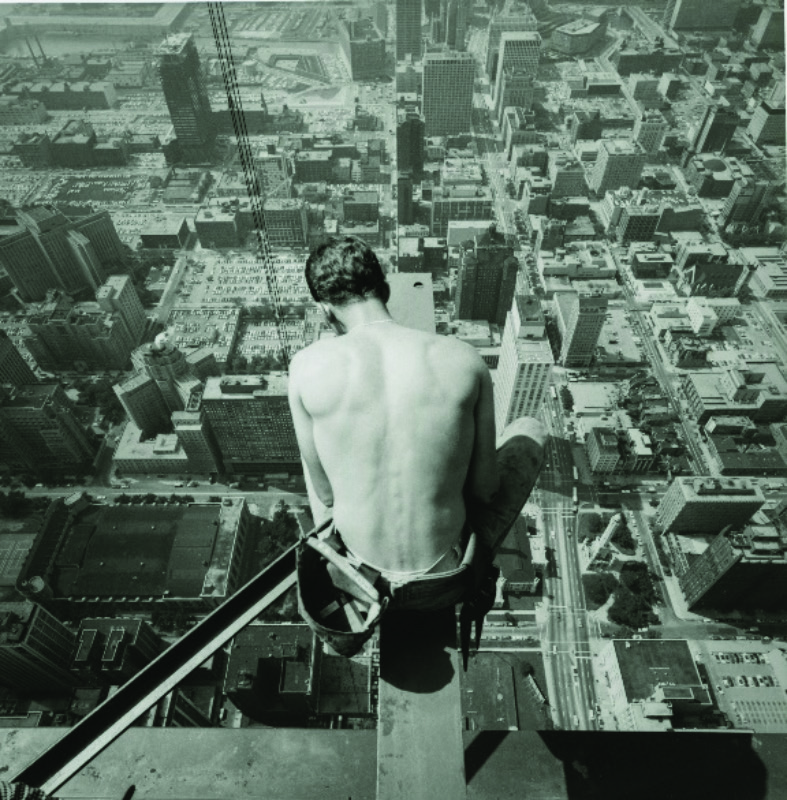
Throughout the 20th century, immigrants arrived in Chicago, impacting the city as much as it shaped and altered the lives of those who settled there. Featuring the work of Lithuanian immigrants of the early and mid-20th century, the exhibition’s opening section, Changing Chicago, captures the dynamic cityscape and surrounding landscapes.
Mapping several decades, Changing Chicago charts the growth of the “Windy City” through the lens of former outsiders who became deeply entrenched in Chicago’s art and design scene during the second half of the 20th century. Immigrating from centuries-old European cities and towns (Vilnius, Lithuania’s capital, was founded in 1323), these artists relished in Chicago’s big-city energy and multi-faceted culture. Here, they discovered new aspirations and artistic forms. Algimantas Kezys’ black-and-white photographs position Chicago’s Lake Point Tower from a neck-craning perspective, evoking awe and wonder at the skyscraper’s dizzying scale. Similarly, the hypnotic headlights on Lake Shore Drive appear foreign yet familiar and immediately entrancing. Edward Walaitis portrays a blustery 1960s autumn afternoon on Michigan Avenue and the syncopated rhythms of the jazz nightclubs on Rush Street. Anthony Cooper [nee Antanas Skupas ] captures a shore-line view of bustling commerce on the Chicago River. Mikas Šileikis’ romanticized, impressionistic views of Belmont Harbor and the Indiana Dunes in the 1960s and ‘70s hint at the subtle way Lake Michigan may have restored memories of Lithuania’s Baltic Sea and its ports.
While poignantly acknowledging the sacrifices inherent in leaving one’s homeland, this segment of the exhibition unfolds like an ode to the artists’ adopted city. Reflecting the immigrant experience and the pursuit of a new identity, the imagery within Changing Chicago contributes to the tapestry of American art history and stands as a testament to the enduring legacy of Chicago’s Lithuanian artistic community in the 20th century. Jonas Dovydėnas’ photographs capture the essence of Chicago’s South Side church service preacher and musicians and bustling street scenes, inviting spectators to belong in every sense of the word—to witness first-hand the unfolding scenes of life in a rapidly evolving and diverse American city.
Art as Activism
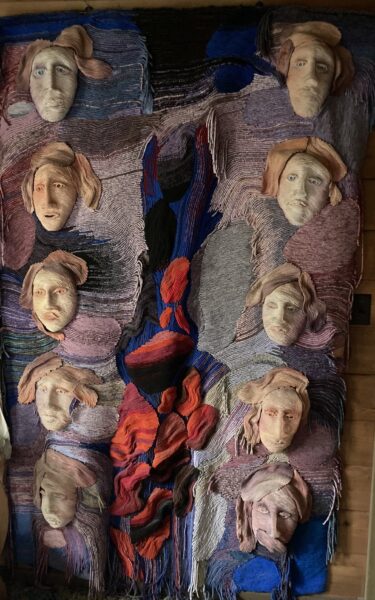
The current war in Ukraine focuses renewed attention on the Baltic region, and the massive population losses and displacements of World War II are cast into high relief. Terms such as immigrant, migrant, exile, and refugee appear interchangeably in the press, although each concept carries its own weight and meaning. Many of the artists in beLONGING endured the ravages of war, including survivor’s guilt and the heartache of leaving behind loved ones—husbands, brothers, sisters, parents, aunts, uncles, and grandparents. In this exhibition’s second section, multi-media paintings, prints, and sculptures focus on the theme of Art as Activism to decipher how Lithuanian artists visualized and processed the trauma of war. Those who crossed the Atlantic fled the atrocities of World War II, seeking survival and refuge, yet their experiences as displaced persons etched lifelong scars, often defining their approach to life and art, local politics, and international conflicts. In Art as Activism, emotive works by Rudolf Baranik, Ada Sutkus, Magdalena Stankūnas, and Petras Aleksa express the unspeakable brutality of war through such universal themes as grief, fear, flight, irony, and the hope for a more peaceful future. Here, the human body emerges as the carrier of suffering and trauma. War, as these artists suggest, is not only psychologically devastating but an enduring somatic experience that leaves wounds slow to heal.
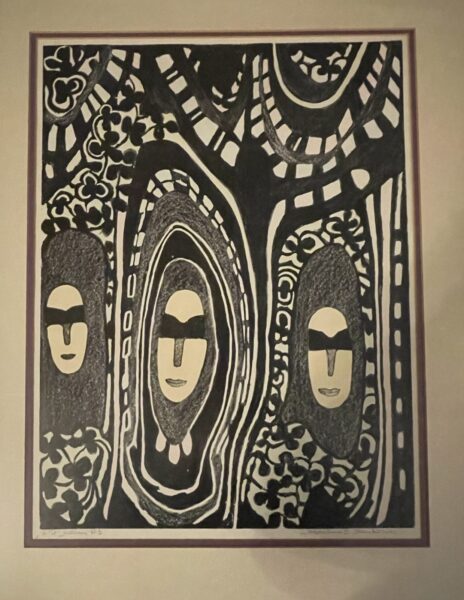
Several works in this section are anchored by a universal sense of anguish and loss that links the experience of war to conflicts past, present, and ominously forthcoming. Rudolf Baranik’s monochromatic multi-media painting Vietnamese Child #1, of his Napalm Elegies series (1967-74), addresses the atrocities endured by children during the Vietnam War and indirectly references the artist’s grief over losing his parents and sister to the Holocaust in Lithuania. Magdalena Stankūnas’ woodcut series, Mothers #1, #2, and #3 of the mid-1970s, recollects Soviet terror through bold figurative abstraction. Here, blindfolds speak of the most callous and vicious of Soviet war tactics: the indoctrination of fear and silence among torture victims’ mothers, who, for fear of retribution, could not openly react to the sight of their children’s publicly displayed, mutilated bodies. Petras Aleksa’s sculpture, The Red Path, likewise represents the victims of communism through a delicate, haunting stack of human skulls. In other works, both Aleksa and Ada Sutkus illustrate the senselessness of military conflict with biting sarcasm. In Peace Conference, Sutkus portrays the feckless and resolute opposing parties to conflict, who fail to build bridges and stem the tide of the flowing river of blood their inaction in the face of war has created.
Evoking the depth of injury perpetrated against the human body and psyche, these artists position art and art-making not only as a form of documenting and protesting war but as an active way to exorcise fear, longing, and loss. Although artists have long served as commentators from the front lines of political and social unrest, these works are infused with a particularly impassioned disposition that places personal experience front and center and boldly challenges viewers to become active witnesses.
Mythic Feminism: Lithuanian Women Artists
Mirroring aspects of the 1960s and ’70s second-wave Feminist movement in the United States, Mythic Feminism: Lithuanian Women Artists presents an expansive selection of works in various media. Seamlessly integrating a wide variety of artistic influences into their work—from the vivid colors of Chicago’s Hairy Who to the evocative iridescence of Op Art and the Feminist Art Movement’s “central core” imagery—works by female artists in this section span several generations and multiple media. Large and small-scale drawings, prints, paintings, ceramics, weavings, and fiber collages introduce the personal and aesthetic dualities with which Chicago-based Lithuanian women artists contended: career and family, heritage and modernism, abstraction and representation.
Founded in Chicago in 1971 by several of the women featured in this section, the Lithuanian American Women’s Artists Association (LAWAA) provided a supportive network of colleagues who tapped into Lithuanian folk art legacy even as they integrated with prominent American and Chicago area artist groups and arts organizations, including the Hyde Park Art Center and ARC Gallery. Taking its name and thematic essence from the 1981 LAWAA exhibition Myths, artworks invoke portrayals of Lithuanian folk legends, classic elements of which continue to resonate (sacrifice, heroism, the alchemical, male and female energies), even as they revise traditional approaches to allegory and aesthetics.
Touching on the continued struggles women artists encounter today, many of the works in Mythic Feminism transcend the moment in which they were made. Ada Sutkus’ Self Portrait of 1975, for example, pictures the artist’s hands reaching out of an egg toward a paintbrush and pencil; birthing five children in four years, Sutkus placed her art career on hold—at least partially—while she raised her family. In other works, Magdalena Stankūnas, Janina Marks, and Vanda Balukas updated the familiar imagery of daily life in rural Lithuania—mundane farm chores or the rhythmic turning of a spinning wheel. Referencing Lithuania’s pagan spirituality, serpents and the traditional male God of Thunder—Perkūnas—appear juxtaposed with feminine rulers, including Lithuania’s one and only Queen, Morta. Conceptually dense, this section of the exhibition creates, as the title of Giedrė Žumbakis’ monoprint collage attests, an “Elusive Universe” that reveals as much about Lithuania’s past as it does about these women artists’ new realities in Chicago.
Sacral Art
Re-creating an immersive, contemplative environment, Sacral Art brings to life Chicago-area churches and synagogues enhanced as sacred spaces through the work of Lithuanian artists. Featuring reproductions and actual slab glass windows, glazed ceramic tiles, and sculptural panels, Sacral Art highlights interdenominational connections between Lithuania’s ancient pagan roots as the last European country to accept Christianity in the late 14th century; its Catholic, Protestant, and Jewish denominations; as well as intersections of Lithuanian, Irish, Spanish, and German-speaking congregations in Chicago.
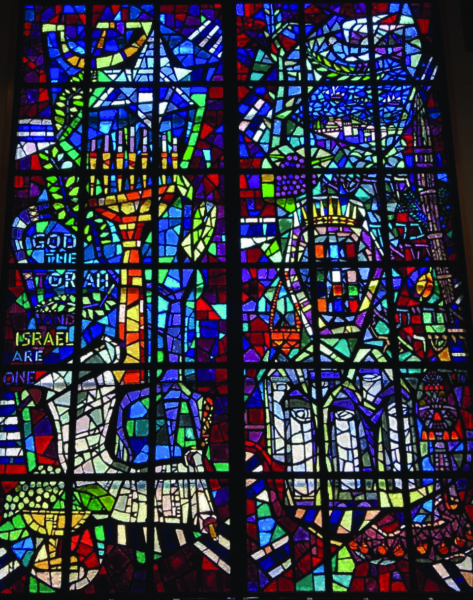
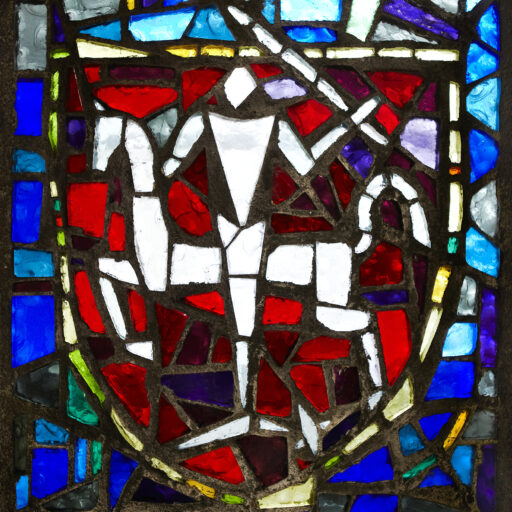
Over nearly a century, such churches as St. Philomena on the North Side, Nativity of the Blessed Virgin Mary on the Southwest side, and Congregation Rodfei Zedek in Hyde Park have been affected by changing demographics. As generations of worshippers have gathered in these sacred spaces, the environments of worship—created by such artists as Adolfas Valeška, Ada Sutkus, Kazimieras Žoromskis, Eleonora Marčiulionis, and Sister Maria Mercedes S .S. C. are valued by the faithful who respectfully maintain the decorative artworks.Featuring a variety of themes, including Stations of the Cross, scenes from the Life of Christ, or slab glass windows such as God, the Torah, and Israel are One, the ways in which diverse congregations have shared in the care of these beloved adornments define multicultural exchange and community in an ethnically diverse and evolving city.
Designed in Chicago
Earning a livelihood in Chicago prompted some Lithuanian émigré artists to devote their professional careers to graphic and industrial design. Alexsandra Eiva honed her skills at the Chicago Transit Authority, developing the public agency’s iconic logo. Others worked with manufacturing and marketing companies. Vincas Lukas, for example, worked as a graphic art director at Popeil Brothers Inc. in the 1970s and later as creative director at agencies where he designed product packaging and retail environments for Motorola and Sears. Photographers Alexas Urba and Kastytis Izokaitis created images for product and fashion advertising. Highlighting the artist’s capacity to fully engage with Chicago’s thriving world of graphic and design businesses, some of these artists continued their careers in the fine and performing arts in addition to their 9-to-5 jobs. Jonas Kelečius, for example, an actor and painter who ran his own sign-painting business, produced iconic signs for Vienna Beef hot dogs. Education at the Institute of Design (IIT) or the School of the Art Institute of Chicago prepared artists for professional work and introduced them to techniques, trends, and vendors whom they relied upon for pro-bono assignments for Lithuanian community activities, such as designing posters and programs for opera and theater events, art exhibition catalogs, creating books, illustrations, and ex libris.
Belonging
Belonging, the exhibition’s final section, visualizes the varied ways Lithuanian artists grew to not only love and accept Chicago as home but also feel at home within the city and its vibrant communities. As many immigrants would attest, the feeling of belonging to a new country, city, and culture is complex, occurring in small and large ways. This section features a group of contemporary artists, including Monika Plioplytė and Aušrinė Kerr, along with their predecessors, Kazys Varnelis and Vytautas Virkau, who achieved acclaim for their bold, contemplative paintings. Through these artists, the exhibition explores concepts of translation and transition: how longing for one’s homeland might eventually develop into a deep sense of belonging elsewhere or in two very different places at the same time.
While the concept of belonging varies for each immigration wave and each individual, most seek to honor and pay homage to their treasured roots, language, and homeland within the context of their new surroundings. Juxtaposing abstract and representational works by such artists as Rimas Čiurlionis and Laimis Urbonas, this final section of the exhibition focuses on the interrelationships of several generations, from the founders of modern Lithuanian art in the early 20th century to contemporary artists living and working in Chicago today.
Comprised of paintings, prints, photographs, and mixed media collages, many works in Belonging visualize the responsibility and privilege of Lithuanian-American dual identity and citizenship. Significantly, many artists in this section worked as teachers at community-based art centers, such as the Chicago Park District, and at universities and art schools, including Northwestern University. Passing down knowledge has been and remains critical to Belonging, where the “old,” the work of preceding generations of immigrant artists, lives alongside and inspires “the new,” the work of contemporary Chicago-based artists today.
Sponsorship
The exhibition is made possible with generous support from the Terra Foundation of American Art, the Lithuanian Foundation, the Lithuanian Culture Institute, the Lithuanian National Museum of Art, May Stevens and Rudolf Baranik Foundation, the Illinois Arts Council, the City of Chicago Department of Culture and Special Events through CityArts, and the members and private donors of the Balzekas Museum.
Public Programs in Development
Unless otherwise noted, all events below are to be held at
the Balzekas Museum’s 6500 S. Pulaski Rd., Chicago IL 60629.
September 29, 2024 – May 17, 2025 Exhibition Dates
Exhibition Guided Tours – Second Saturday of each month at 2 PM or by appointment (Call 773.582.6500) School and Group Tours – please call to arrange a tour:773.582.6500
Publications
Through the assistance and generosity of the Lithuanian National Museum of Art in Vilnius, Lithuania, the beLONGING exhibition will be accompanied by a scholarly catalog featuring essays by exhibition curator Victoria Kašuba Matranga, and contributors from the U.S. and Lithuania, including Rolf Achilles, Dr. Jolanta Bernotaitytė, Dr. Giedrė Jankevičiutė, Dr. Dalia Kuizinienė, Dr. Indra Lācis and Dr. Rasa Žukienė.Publication is expected in Spring 2025.
With partial support from the May Stevens and Rudolf Baranik Foundation, the Balzekas Museum will translate and publish Winter Night Sky Elegies, a biography of Rudolf Baranik by Lithuanian author Rimantas Vanagas, 2020. Editor Victoria Matranga. Publication is expected in Spring 2025. Preorders for the catalog and the Baranik biography are available through the Balzekas Museum of Lithuanian Culture’s Gift Shoop.
Exhibition admission: Free with general admission to the Museum
beLONGING: Lithuanian Artists in Chicago, 1900 to Now exhibition is part of Art Design Chicago, an initiative of the Terra Foundation for American Art in partnership with artists and organizations across the city. Art Design Chicago is a series of events and exhibitions that highlight the city’s artistic heritage and creative communities. More>
Additional sponsors include the Lithuanian Foundation, the Lithuanian Culture Institute, the Lithuanian National Museum of Art, May Stevens and Rudolf Baranik Foundation, the Illinois Arts Council, the City of Chicago Department of Culture and Special Events through CityArts, Chicago Sister Cities International Vilnius Committee, and the members and private donors of the Balzekas Museum of Lithuanian Culture.